The traditional communications system appeared in the early 1960s and was considered a revolution in the world of telecommunications, offering excellent voice quality and a reliable communications system. It remained dominant in the telecommunications field for more than half a century due to the absence of a strong competitive alternative.
At the beginning of the new century, communication systems that rely on a company’s internal network and the Internet, known as IP-PBX systems, appeared and began to break the dominance of the traditional PBX world.
With the rise of smartphones and apps, and following the COVID-19 pandemic, the true value and actual capabilities of modern IP-based communication systems (IP-PBX) have become evident, with an annual growth rate of about 10.4%.
The modern communications market is expected to reach about $87.2 billion by 2035 (source).


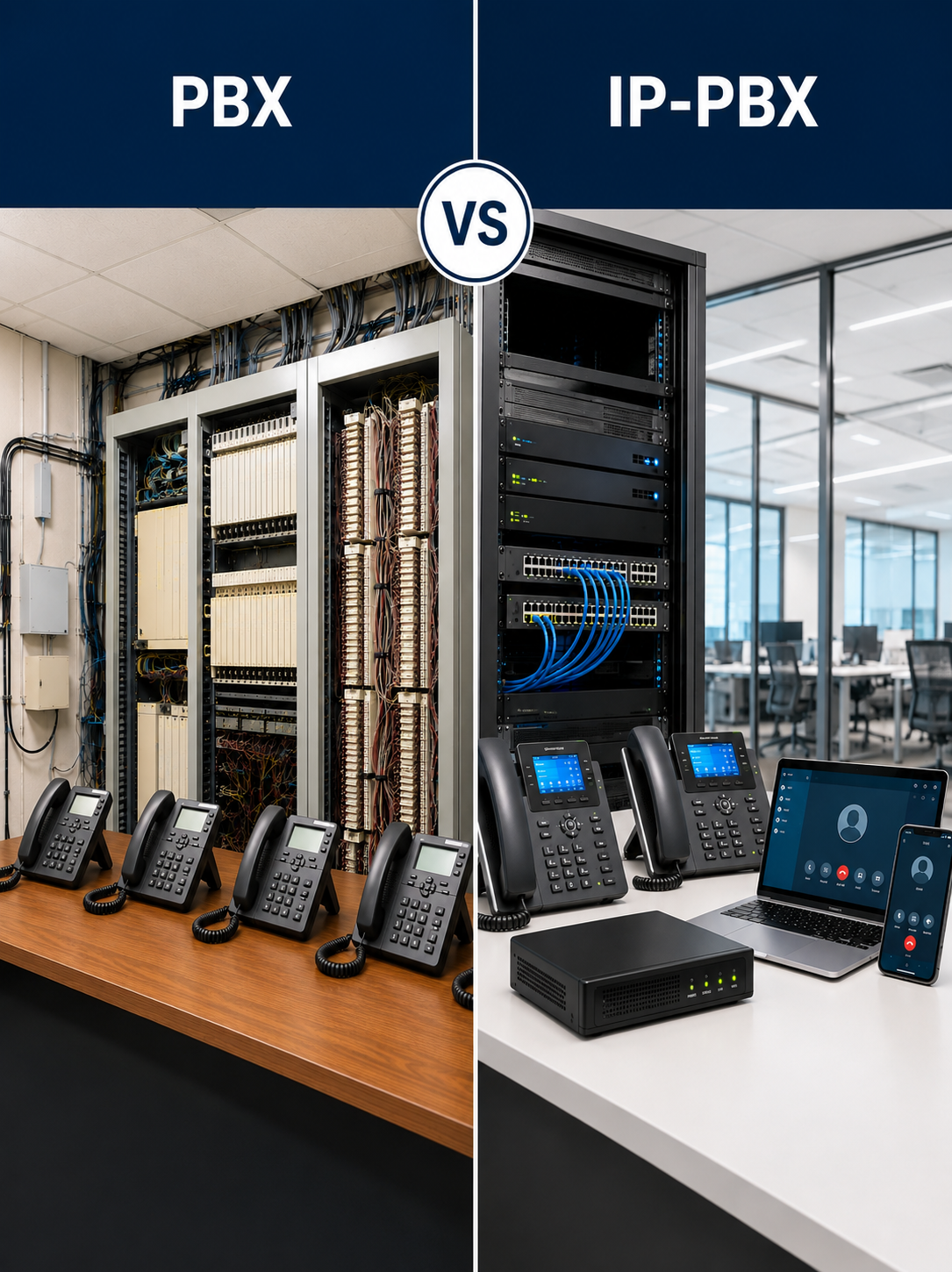
What is the traditional PBX communication system?
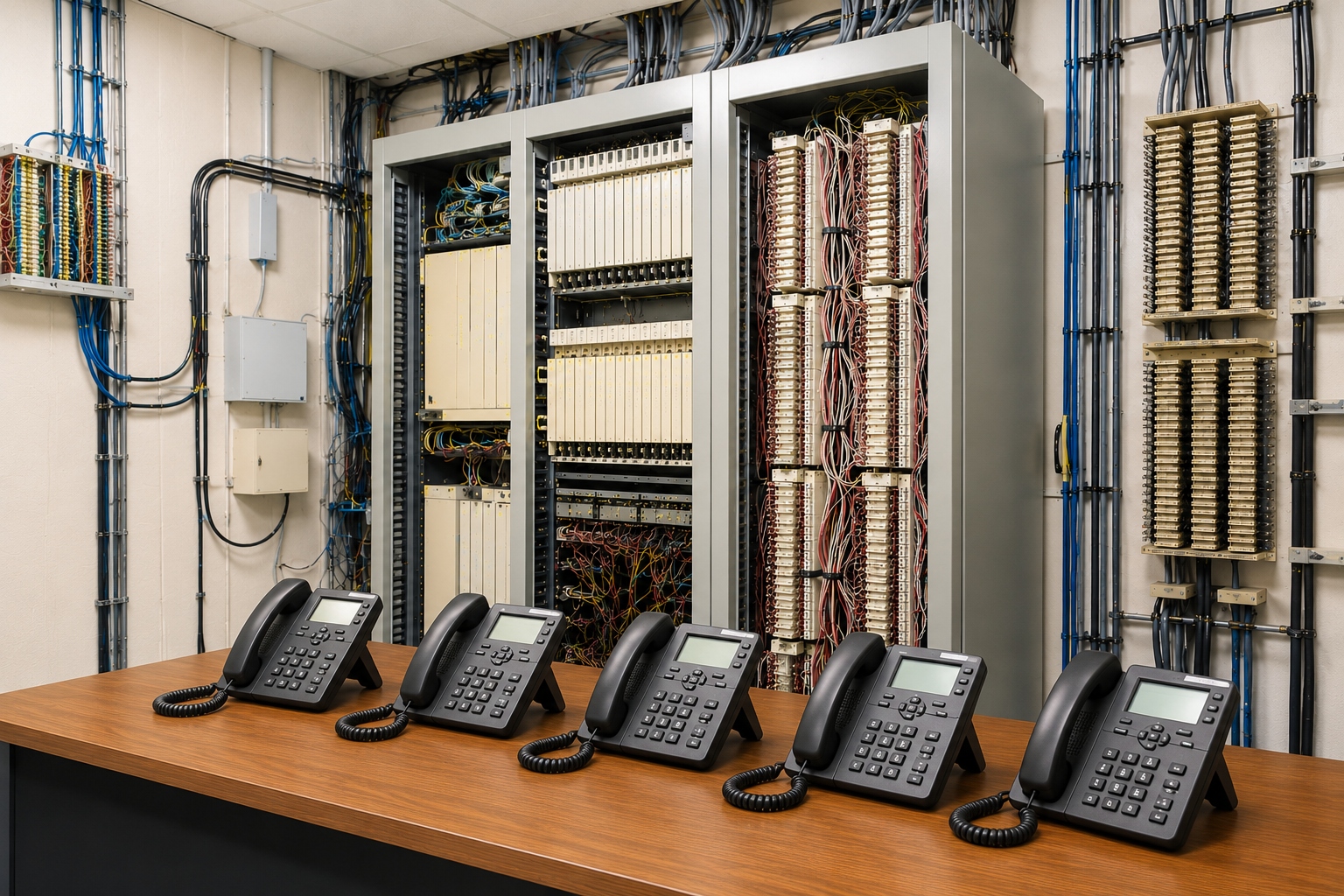
Private Branch Exchange (PBX) is an internal communication system within a company that allows making and receiving calls inside the organization using traditional analog phone lines. It relies on physical hardware installed on the company’s premises. The company’s headquarters can also be connected to its branches through the public switched telephone network (PSTN).
This system was designed to simplify company communications. Previously, companies needed separate phone lines for each employee to make calls, and all calls had to go through the public switched telephone network (PSTN). However, with the introduction of the traditional PBX system, internal communication between employees became free of charge and no longer required passing through the public telephone network.
What are its components?
- Depends on copper cables
- Analog / ISDN / PRI lines
- Automatic Call Distributor (ACD)
- Standard analog telephones
What is a network-based communication system (IP-PBX)?
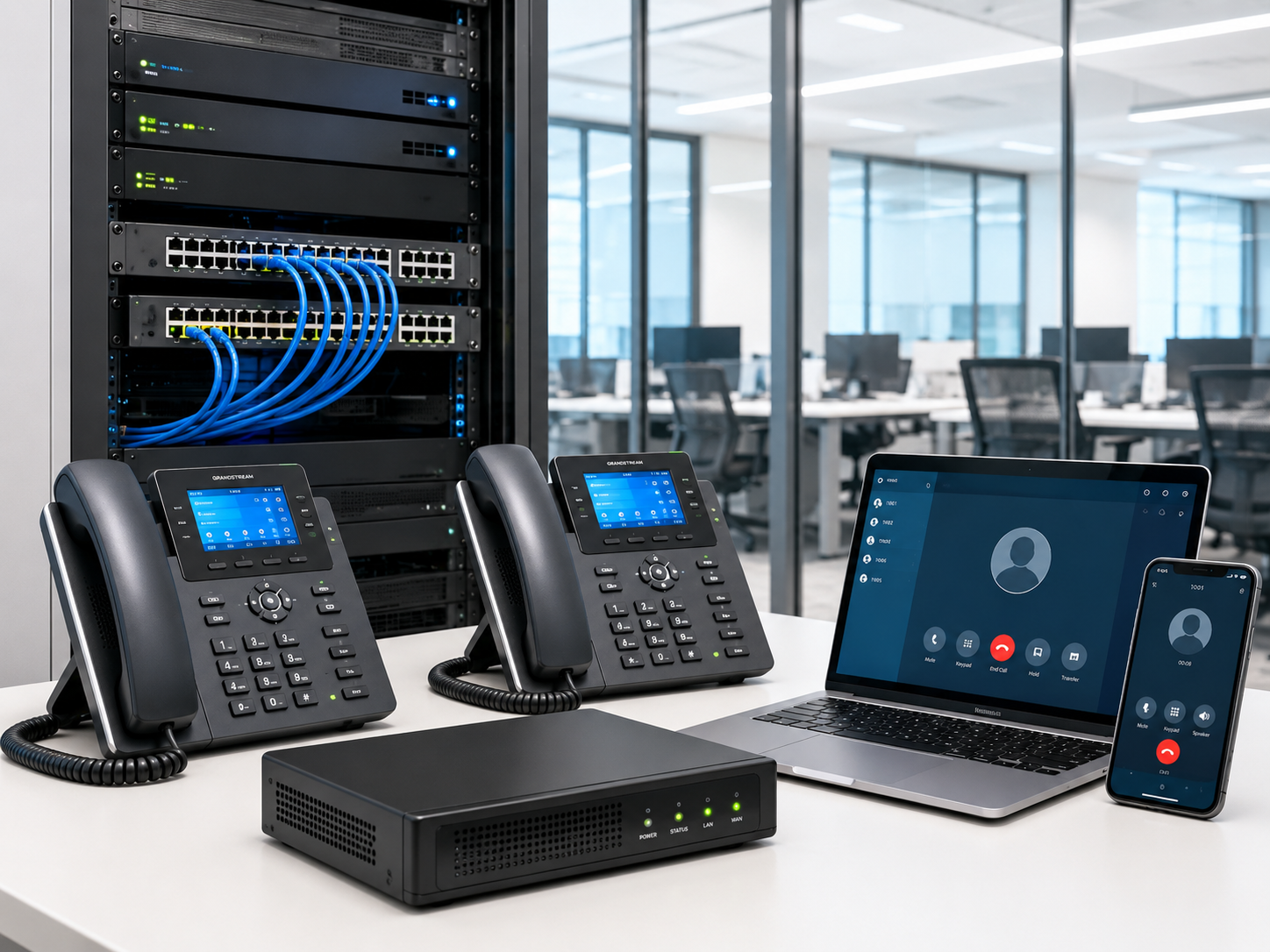
A network or internet-based phone system is the latest generation of private branch exchange (PBX) technology and operates over internet protocols (VoIP).
VoIP (Voice over Internet Protocol) is a technology that converts voice call signals into digital data packets and transmits them over the Internet instead of traditional landlines. It is also known as Internet Protocol (IP) telephony. This allows users to make calls over a company’s internal LAN network or the Internet using hardware devices or software applications.
Thanks to its numerous advanced features, VoIP provides modern and inexpensive communication solutions for businesses. Companies benefit from functionalities such as auto attendants, interactive voice response (IVR) systems, and analytics tools to streamline their communications. This makes VoIP technology more feature-rich and more affordable than landline services.
What are its components?
- A server operating with the SIP protocol
- Local Area Networks (LAN) and the Internet
- IP phones (networked telephones)
- Mobile or browser-based applications and Windows software
📊 Communication Systems Comparison
| Aspect | Traditional Communication System (PBX) | Network-Based Communication System IP-PBX (VoIP) |
|---|---|---|
| Installation | Complex and numerous devices requiring a specialised team | Simple and less complex devices |
| Connection | Via landlines (PSTN/PRI) | Via the internal network and the Internet |
| Installation costs | High (installation, operation, and configuration) | Low, mainly dependent on IP Phone |
| Operating costs | High call costs (monthly line subscriptions - maintenance) | Call costs are almost zero – with cloud-based systems, only a minimal monthly subscription fee is required |
| Hardware | A separate phone must be purchased for each employee | A separate phone is not required for each employee, mobile apps or browser can be used |
| Scalability | Difficult, expensive, inflexible, and time-consuming | Much easier, low-cost, and flexible |
| Features provided by the system | Very limited | Highly advanced features and numerous smart tools |
| Integration with other systems | Very limited integration | Complete flexibility for integration with any system |
| Maintenance and Upgrades | Requires a specialized IT team to maintain and upgrade the system. | The service provider handles all maintenance and upgrades. |
| Security and protection | No cyber threats | There is a possibility of cyber threats, which can be reduced by using standard security measures and proper encryption. Additional protection, such as a firewall, may be required to prevent breaches. |
Which phone system should you choose: PBX or IP-PBX (VoIP) ?
The choice between PBX and VoIP systems depends on the size of your business, your budget, your specific needs, and your business requirements.
A traditional PBX communications system is a reliable and secure option for businesses that require standard call quality and have an existing infrastructure for traditional telephones. However, it is expensive and requires high initial and maintenance costs.
In comparison, the network-based VoIP communication system offers a modern and cost-effective solution for all businesses, whether small, medium or large, thanks to its flexibility and powerful features.
XonTel is considered a leader and one of the best PBX companies that develops and manufactures IP PBX systems.
XonTel offers the latest technologies that compete with global brands at competitive prices, along with a professional, highly skilled support team dedicated to accurately meeting all customer needs with high efficiency, making it the best choice.
Frequently Asked Questions (FAQ)
What is an IP-PBX communications system?
An IP-PBX is a phone exchange that manages internal and external calls using the internet or the company’s local network. It can be linked to IP phones, mobile apps, computer software, and browsers to provide a unified communications system for employees and branches.
What is VoIP technology and how does it work?
VoIP, or Voice over Internet Protocol, converts voice into digital data packets that travel over the internet or an internal network instead of traditional phone lines. When the data reaches the other end, it’s converted back into voice so the user can hear the call normally.
What is the difference between a traditional PBX system and an IP-PBX system?
A traditional PBX relies on phone lines, copper wiring, and dedicated physical equipment within the company, while an IP-PBX relies on the data network and internet protocols to transmit calls. IP-PBX offers greater flexibility for scaling, remote work, and integration with company systems.
What are the key advantages of relying on VoIP technology and an IP-PBX system for businesses?
A VoIP system offers modern, advanced solutions including:
- Cost reduction: call costs are nearly nonexistent compared to traditional landlines.
- Flexible use and devices: no need to buy a physical phone for every employee, since smartphone apps or a browser can be used instead.
- Easy scalability: the ability to add new lines and users easily, without complexity or steep costs.
- Advanced features: support for smart tools like Interactive Voice Response (IVR), auto-attendant, and flexible integration with various other systems.
Is an IP-PBX system the same as a VoIP system?
They’re not exactly the same thing, but they’re related. VoIP is the method used to transmit voice calls over the network, while IP-PBX is the system that manages calls, users, transfers, queues, and phone features using VoIP technology.
Is VoIP call quality better than traditional phones?
A VoIP system can offer high voice quality when there’s a stable network, correct settings, and compatible equipment. Call quality depends on network speed, response time, data packet loss, and QoS settings, as well as the type of voice codec used.
How does an IP-PBX system help support a remote work policy and multiple company branches?
An IP-PBX system excels at easily connecting branches and employees regardless of their geographic location; an employee can use a softphone app or their personal computer to answer work calls exactly as if they were sitting at their desk at the head office, without needing complex wiring or paying high international call fees between company branches.
What is needed to move from a traditional PBX system to an IP-PBX system?
The transition usually doesn’t require completely changing the infrastructure, since the existing local computer network (LAN) can be used. The basic requirements include:
- Providing a SIP server or relying on modern PBX solutions.
- Using IP phones or activating smartphone apps.
- Ensuring the router and switches are capable enough to support voice data traffic clearly and stably.