Unified Communications (UC) is a new technological approach or method for achieving integration and coordination of communication channels. It combines communication tools to enable companies and organizations to manage all their communications as a single entity, while still allowing each to be managed independently.


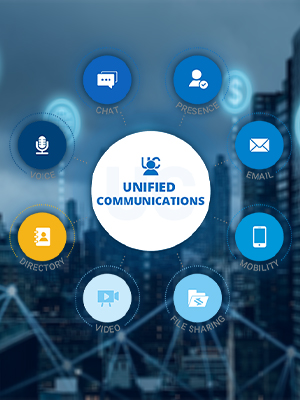
What is Unified Communications (UC) and How Does It Work?
As previously defined, Unified Communications integrates multiple communication methods. UC works by synchronizing real-time communication services—such as phone calls, instant messaging or chat, presence information, call management, and video conferencing—with non-real-time communication tools, such as voicemail, email, SMS, and fax.
UC allows a user to send a message on one platform and have it appear on another. For example, a voicemail can be accessed through email or a mobile phone, and the user can immediately respond via text chat or video call.

Advantages of Unified Communications
Most UC advantages focus on increasing employee productivity, providing fast and seamless communication, and completing tasks more efficiently. Large organizations also gain additional benefits by integrating communications into their administrative processes.
Key advantages include:
1. Device Flexibility
Employees can receive voice and video calls inside or outside the office on any device (computer or smartphone).
2. Faster Communication
Quick access to the right person at the right time through presence information and real-time status updates.
3. Integration with Enterprise Applications
UC can be integrated with systems like Customer Relationship Management (CRM), Customer Service Management (CSM), or Enterprise Resource Planning (ERP).
4. Cost Reduction
Lower communication costs and enhanced Internet Protocol (IP)-based communications.
5. Future Scalability
UC is the ideal solution for future expansion, enabling businesses to scale easily and quickly.
6. Competitive Advantage
Small and medium enterprises can operate and compete with large global companies using the same communication capabilities.
7. Centralized Management
All company communications can be created, unified, and managed from a single location or under one roof.
From the above, it’s clear that Unified Communications bridges the gap between VoIP and other computer-based communication technologies.
Sahab Technology is the first leading Arab company in the field of unified communications, offering its products through XonTel.
For more information about XonTel products and services click here
Follow us on LinkedIn
Frequently Asked Questions (FAQ)
What is Unified Communications and how does it work?
It is an advanced technical solution that integrates real-time communication methods (such as phone calls, call centers, video chat, and instant messaging) with non-real-time communication methods (such as voicemail, email, and SMS) into a single administrative entity, allowing employees to manage all communication channels seamlessly from one place.
What are the key benefits of Unified Communications for businesses?
Unified Communications helps accelerate communication, improve team collaboration, reduce the time needed to reach the right employee, unify communications management, and support both in-office and remote work.
How does Unified Communications contribute to raising the efficiency and productivity of teams?
Unified Communications allows employees to receive voice calls and video calls whether inside or outside the office, and via any device (computer or smartphone), ensuring quick access to the right person, completing transactions in the shortest time, and enhancing the speed and transparency of communication.
Can call center systems and other enterprise software be integrated with Unified Communications platforms?
Yes, one of the key advantages of this technology is the ability to seamlessly connect call centers and various enterprise systems (such as Customer Relationship Management/CRM systems or Enterprise Resource Planning/ERP systems) within the unified communications ecosystem, supporting administrative operations and improving the customer experience.
What is the difference between Unified Communications and call centers?
Unified Communications serves the internal and external communication needs of all employees in an organization, while call centers focus more on managing customer and agent interactions, waiting queues, reporting, and service quality monitoring.
Can Unified Communications be managed from one place?
Yes, modern systems provide a centralized management dashboard that allows adding users, managing transfers, policies, devices, and services, and monitoring system performance from a single location.
Can Unified Communications be expanded in the future?
Yes, scalability is one of the key advantages of Unified Communications, as new users, branches, and communication channels can be added without the need to completely rebuild the system.
What is the difference between unified communications and multi-channel communications?
Multi-channel communications provide more than one channel for communication, but each channel may operate separately. Unified Communications, on the other hand, connects these channels, users, and devices within a single system that provides a more integrated experience.