Today, companies of all sizes rely heavily on modern communication networks and systems to remain competitive and achieve their goals.
With the advancement of communication technology, traditional phone networks no longer provide the flexibility or efficiency required to keep up with technological developments and meet customer expectations. This is one of the main reasons businesses are shifting to internet-based communication systems (VoIP), which offer numerous advantages, greater flexibility, high efficiency, and very competitive costs compared to traditional phone systems.
What is SIP Trunking?
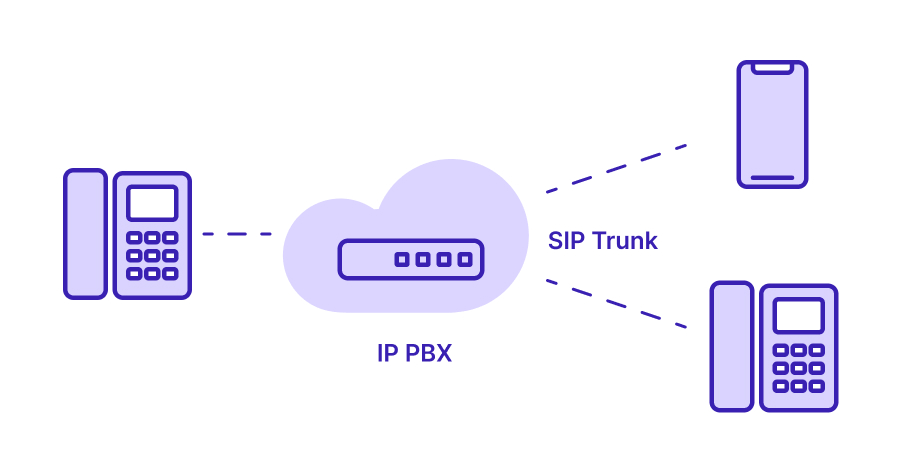
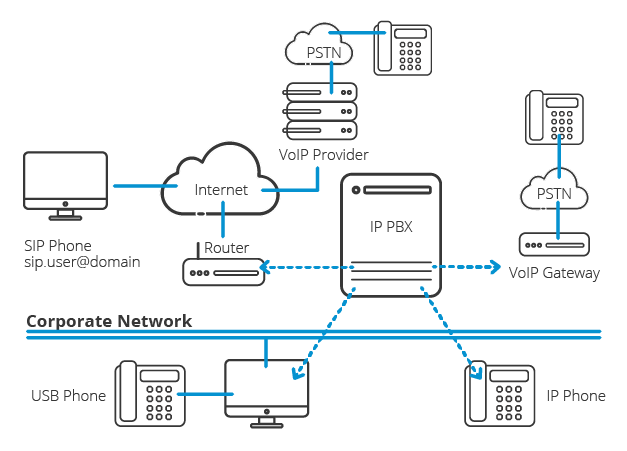
SIP Trunking is essentially the connection of your company’s internal phone system to the internet. Companies no longer need to rely on traditional telephone lines to meet their communication needs. Through SIP Trunking, businesses can connect branches or offices worldwide without using the traditional PSTN (Public Switched Telephone Network). Calls can be routed via the internal phone network or the local PSTN at the destination. These services are provided through SIP Trunk service providers.
Benefits of SIP Trunking:
SIP Trunking provides many advantages for business owners and companies beyond just cost savings. Here some benefits of SIP Trunking:
End of Separate Voice and Data Networks:
With SIP technology, there is no need to maintain separate networks for voice and data services, SIP unifies communication and data networks, making them more flexible by combining voice and data services into a single network.
Cost Savings of Up to 60% on Monthly Communication Expenses:
All calls become internal or local rate calls, This is because it actually relies on the internet for calls and connecting your company’s branches worldwide.
This virtually eliminates international call rates, as it connects you to a phone network in another country, Calls are then transferred to the local phone network, making all calls local.
Rapid Geographical Expansion:
By using networks to integrate voice and data, SIP allows you to connect remote business locations and branches easily without complications. The primary connection factor is the internet, which is available in almost all countries worldwide at competitive prices and bandwidth capacities.
Reduced Infrastructure Costs:
Avoid the expense of purchasing costly equipment and devices for traditional PSTN communication networks and expensive TDM-gateway devices.
Infrastructure Costs and Return on Investment:
Transitioning from traditional PSTN phone networks to VoIP and SIP services is one of the most cost-effective approaches, requiring only minimal investment costs. Converting to SIP internet phone services will require only some dedicated phone devices, and you may also need to install a firewall for network security to maintain the security of information and data in your company.
Most companies that rely on VoIP SIP services achieve a fast return on their investments, often in less than six months.
XonTel is one of the most important companies in the Arab world, providing SIP solutions, internet-based communication systems, SIP Trunk services, and all modern communication solutions for businesses and individuals.
For more information about XonTel’s services and products, click here
Frequently Asked Questions (FAQ)
What is SIP Trunk?
SIP Trunk is a service that connects a company’s PBX to the telecom provider’s network over the internet using the SIP protocol, enabling calls to be made and received without fully relying on traditional telephone lines.
How does SIP Trunk work?
The service provider connects the company’s IP-PBX to the communications network over the internet. When a call is made, the PBX sends the call request to the SIP provider, which routes the call to the desired number through the available networks.
What is the difference between SIP Trunk and VoIP technology?
VoIP is the general technology used to transmit voice over internet networks, while SIP Trunk is a service that connects a company’s PBX to a telecom provider to make and receive calls using this technology.
What are the benefits of SIP Trunk for businesses?
Benefits of SIP Trunk include lower communication costs, branch connectivity, easily increasing the number of communication channels, support for multiple numbers, improved scalability, and reduced reliance on traditional phone lines.
What is meant by SIP Trunk channels?
SIP Trunk channels refer to the number of simultaneous calls a company can make or receive at the same time. A company may have a large number of extensions, but it only needs a number of channels that matches the volume of simultaneous calls.
How do I determine the number of SIP Trunk channels my company needs?
The number depends on call volume during peak times, the number of employees, and the ratio of incoming to outgoing calls. Call logs should be reviewed to determine the maximum number of simultaneous calls, then a margin should be added for growth and emergencies.
Can company branches be connected using SIP Trunk?
Yes, multiple branches can be connected under a unified communications system, with transfers and calls managed from a central or cloud PBX, making internal communication easier and reducing the cost of connecting between locations.
Is SIP Trunk secure?
It can be secure when using a firewall, strong passwords, IP address restrictions, keeping the PBX updated, monitoring calls, and encrypting SIP and voice when supported by the provider and the system.