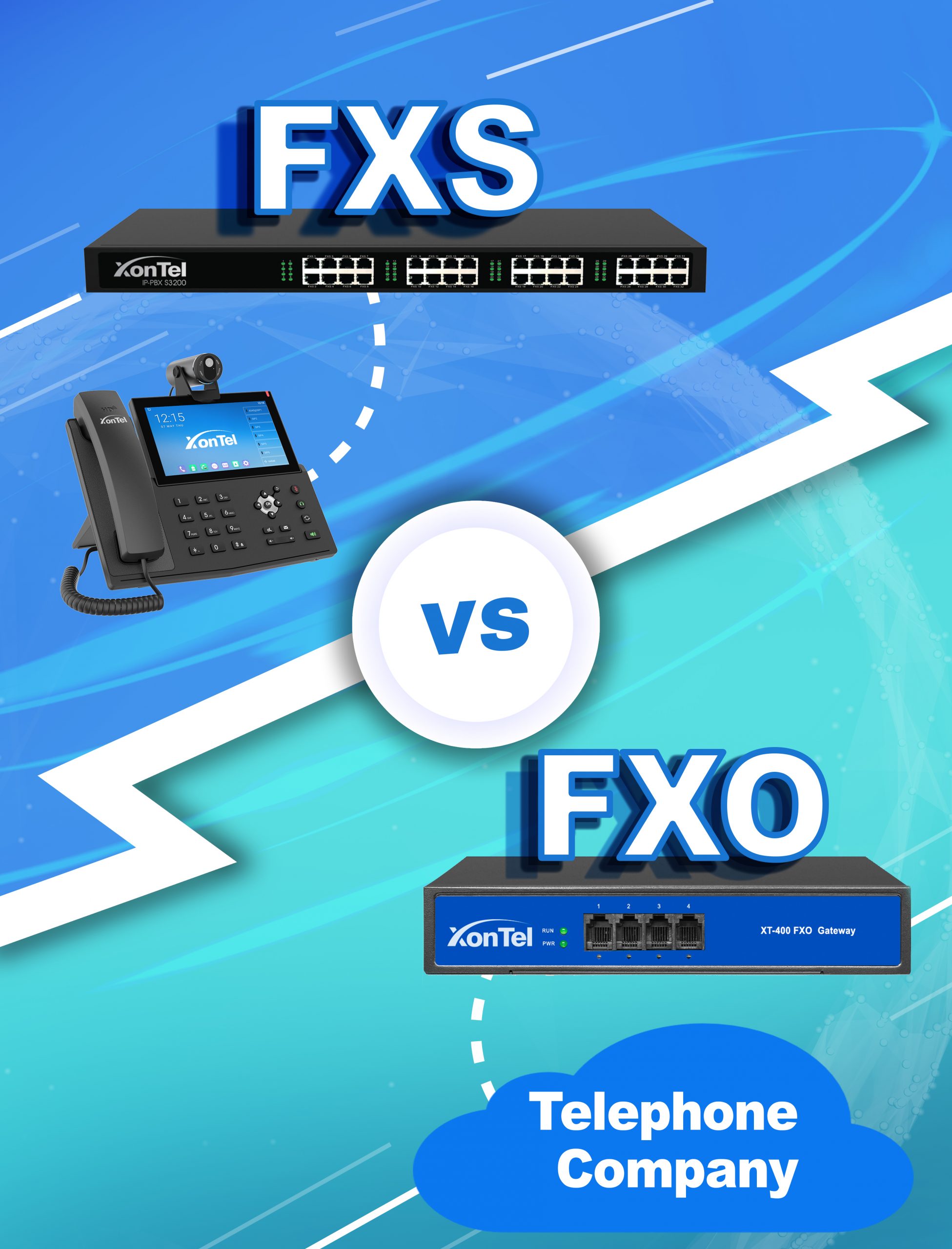
What are FXS and FXO ports

FXS Gateway FXO Gateway

What are FXS and FXO ports? What are they used for?

What is an FXS port?

FXS stands for foreign exchange subscriber. An FXS port is an interface that connects station devices such as your phones or PBX to a VoIP adapter.

FXS is an RJ11 port that connects internally to an analog office phone or fax machine.  Think of the S as meaning a station or a cubicle. Any FXS port is going to connect to an analog DEVICE and the cable from the port to the device will never leave the building.

Now, on to the FXO ports…

What is an FXO port?

FXO stands for foreign exchange office. An FXO port is an interface that connects your Plain Old Telephone Service (POTS) line to a VoIP adapter.

It designates a telephone signaling interface that receives POTS (plain old telephone service). Um… ok. Let’s put it this way, FXO is a port that will connect a device to an outside telephone line.  Think “O” for “Outside”. Picture an RJ11 wall jack that connects to a box in your basement which is connected to the line from your house to the nearest telephone pole on your street. Any RJ11 port on a device that is headed towards that wall jack is an FXO port. It connects your device to the “outside” world or your local area telephone “office”.

FXS and FXO Ports With VoIP Phone System

FXS Gateway

An FXS gateway is used to connect one or more lines of a traditional PBX to a VoIP phone system or provider. Alternatively, you can use it to connect analog phones to it and re-use your analog phones with a VoIP phone system. You need an FXS gateway because you want to connect the FXO ports (which normally are connected to the telephone company) to the Internet or a VoIP system.

XonTel offers cost-effective Series S3200 FXS VoIP Gateway for small and medium enterprises to ensure an effortless and smooth transition to VoIP. By integrating traditional phone systems into IP-based systems, you can provide employees with a robust IP telephony feature set and will not have to allocate huge investment on new VoIP phones but, instead, continue using the existing analog phones as extensions of the IP-PBX.

FXO Gateway

An FXO gateway is used when you want to connect a VoIP system with analog lines and translate analog lines to establish a VoIP call.

XonTel  XT-400 FXO VoIP Gateway provides an affordable and reliable solution that can connect analog lines and PABX extension interface to SIP trunks, enabling making calls over the Internet.

When connected to a headquarter IP PBX system, FXO gateways can use the local landlines of your remote sites to avoid long distance rates. Besides, in the event of a network crash and SIP trunking to IP-PBX fails, FXO Gateway can offer a failover or fallback solution by connecting your PBX to an outside telephone line.

E1 Gateway:

SIP/E1 Media Gateway – Digital VoIP gateway is used in different options of conjugation of VoIP and TDM/PSTN networks for minimization of expenses and reduction of operational costs. Support for all types of signaling used in the PSTN network allows the use of Terratel VoIP gateway for the reconstruction and modernization of various telecommunications equipment. SIP/E1 Media Gateway supports call routing in any order TDM-to-SIP,  SIP-to-TDM,  TDM-to-TDM, and SIP-to-SIP.

Frequently Asked Questions (FAQ)

What is an FXS port?

An FXS port is a port used to connect analog internal devices, such as a regular phone or fax machine, to a VoIP system or IP-PBX. The port supplies the device with line signal, dial tone, and the ringing voltage needed to receive calls.

What is an FXO port?

An FXO port is a port used to connect a VoIP system or PBX to an external analog telephone line coming from the telecom company, or to an analog output from another PBX. An FXO port receives dial tone, ringing, and line signals from the corresponding FXS port.

What is the difference between an FXS port and an FXO port?

The main difference is that an FXS port provides line service to an analog device, while an FXO port receives that service from an external telephone line. So, an FXS port is used to connect phones and fax machines, while an FXO port is used to connect traditional telephone lines to a VoIP system or PBX.

What devices can be connected to an FXS port?

Analog phones, fax machines, and some intercom devices and traditional PBXs can be connected to an FXS port, provided the device is compatible with the analog phone line and the settings of the gateway used.

What devices or lines are connected to an FXO port?

An FXO port is connected to analog landlines, analog PBX outputs, or ports that provide dial tone and ringing. This allows calls to be routed between the traditional phone network and a VoIP system.

What is an FXS Gateway, and when does a company need one?

An FXS gateway is a device that converts communication between a VoIP network and analog devices. The gateway has one or more FXS ports for connecting old phones and fax machines and using them as extensions within an IP-PBX system.
A company needs an FXS gateway when it wants to keep its existing analog phones or fax machines and connect them to an IP PBX or VoIP service. This helps transition to modern communications without replacing all the old equipment.

What is an FXO Gateway, and when does a company need one?

An FXO gateway is a device that connects external analog telephone lines to a VoIP system or IP-PBX. The gateway receives calls from traditional lines and converts them into calls over Internet Protocol, and also allows the system to make calls through these lines.
A company needs an FXO gateway when it wants to connect its existing landlines to a VoIP system, use local lines at branches, or provide a backup call path in case the SIP Trunk or internet connection fails.

What is the difference between an FXS gateway and an FXO gateway?

An FXS gateway connects analog devices, such as phones and fax machines, to a VoIP network. An FXO gateway connects external analog telephone lines to a VoIP system. The choice of gateway depends on what you want to connect: an analog device or an external telephone line.

call2action-En

For more information about XonTel products and services, leave your data and one of our specialists will contact you